Google’s Willow quantum processor demonstrates quantum contextuality at 105-qubit scale
Google Quantum AI reported in Science that its 105-qubit superconducting Willow processor won a quantum contextuality game 98.30 percent of the time, exceeding the classical limit of 88.89 percent. The team also measured a contextuality indicator of 5.590 against a classical ceiling of 4 and a quantum maximum of 6, verified entanglement across 45 qubits, and ran a hidden linear function algorithm on up to 105 qubits with success probability above 50 percent.
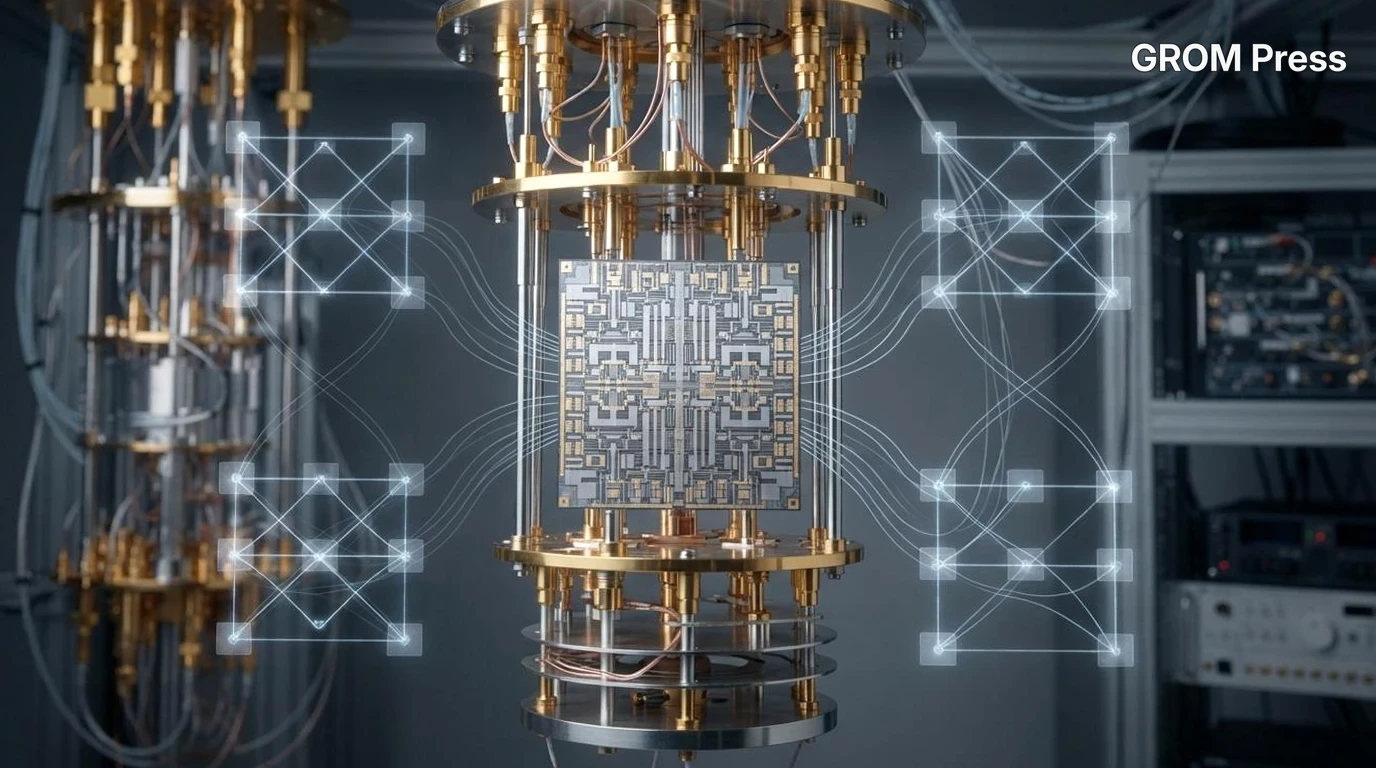
Google Quantum AI has published results in Science showing that its 105-qubit superconducting processor Willow exhibits quantum contextuality at scale. Contextuality is a property of quantum systems in which the outcome of a measurement depends on which other compatible measurements are performed at the same time. The researchers say this property may be one of the physical resources behind the advantage of quantum algorithms over classical computation.
To test the property, the team used a magic square game. In this game, two participants must fill a row and a column of a 3 by 3 grid with plus one or minus one without communicating. They win if their entries match in the intersecting cell. Any pre-agreed classical table can win at most 8 out of 9 rounds, or 88.89 percent. Google played all nine versions of the game 100,000 times each and reported a win rate of 98.30 percent plus or minus 0.01 percent. That means the processor lost roughly one game in 60, while any classical strategy must lose at least one in nine.
The team also measured contextuality directly using the Bell-Kochen-Specker inequality. For classical systems, the indicator chi cannot exceed 4, while quantum mechanics allows up to 6. Google obtained chi equal to 5.590 plus or minus 0.008, which is clearly above the classical boundary and about 7 percent below the quantum limit. The company noted that the test is independent of the initial qubit state, so the result characterizes the processor itself rather than a specially prepared dataset.
Read the full story on GROM.PRESS
Source: GROM.PRESS