Northwestern University scientists place one million microscopic crystals on a 2 by 2 centimetre chip
Researchers at Northwestern University in the United States have created a 2 by 2 centimetre chip holding one million microscopic crystals, a platform called Megalibrary designed to accelerate the search for materials for solar panels, LEDs and semiconductors. The chip also revealed an unexpected change in bandgap width with increasing bromine content and a core-shell crystal structure.
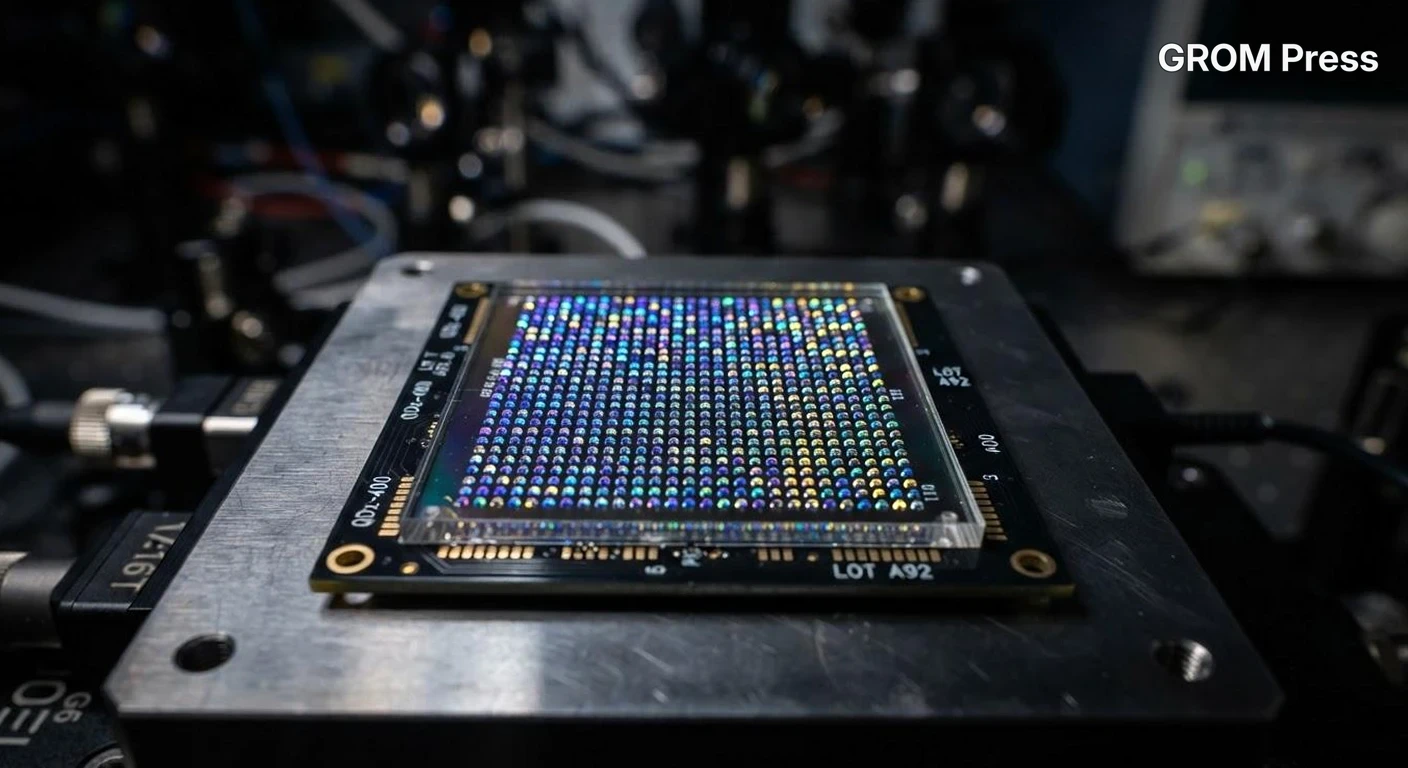
Scientists at Northwestern University in the United States have developed a miniature chip measuring 2 by 2 centimetres that contains one million microscopic crystals, the university reported. The platform, named Megalibrary, is intended to speed up the search for materials for future electronics, including solar panels, light-emitting diodes and semiconductors.
To make the chip, researchers covered a glass substrate with a special polymer and formed one million microscopic indentations in it. They then applied four chemical solutions with different proportions of caesium, bismuth, antimony, bromine and iodine. After heating to 70 degrees Celsius, crystals about 10 micrometres in size grew inside the indentations. As a result, a single chip gathered samples with one million different composition combinations.
The research also produced an unexpected finding. Scientists discovered that increasing the bromine content does not always widen the material's bandgap, as usually happens with similar perovskites. Instead, the width first rose to 2.4 electronvolts, then fell to about 2.15 electronvolts, and in some samples reached 2.11 electronvolts.
Read the full story on GROM.PRESS
Source: GROM.PRESS