Microsoft introduces RDMA over USB4 for running large AI models across multiple Windows PCs
Microsoft has released a preview of RDMA over USB4 for Windows, allowing two or more USB4-equipped PCs to share memory and GPU resources for a single local AI model. The company demonstrated the technology on three mini PCs with Ryzen AI Max+ 395 processors and 128 GB of RAM each, running the Qwen3-235B-A22B model with 4-bit quantization. Microsoft reported approximately 18.5 tokens per second, while AMD reported 21.98 tokens per second using its own configuration. The NetworkDirect provider for USB4 and a llama.cpp-based test platform are open-source projects.
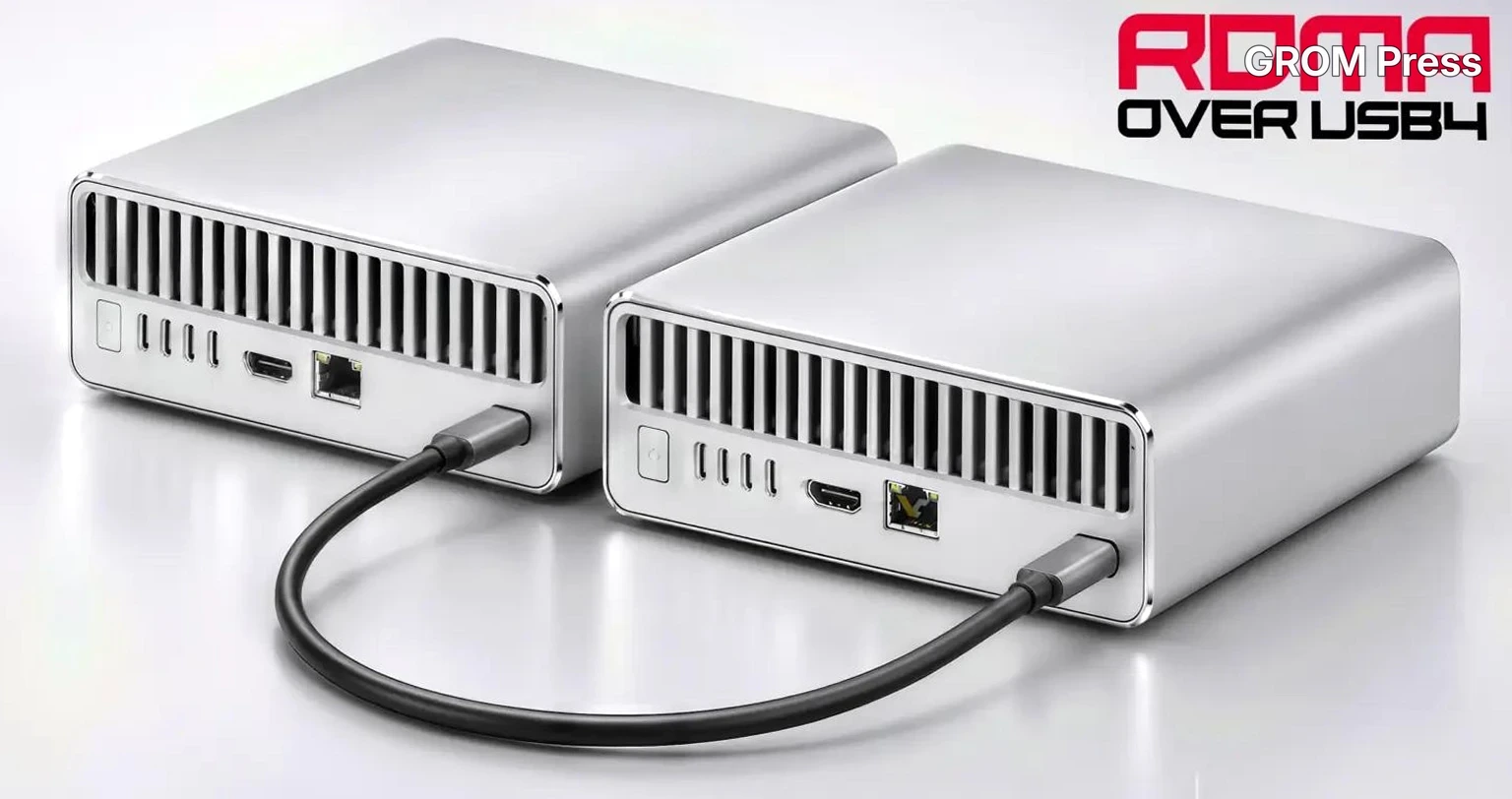
Microsoft has announced a preview release of RDMA over USB4 for Windows, enabling multiple PCs to operate as a single system for running larger local AI models. The technology allows two or more Windows computers with USB4 ports to be connected via USB4 cables and share memory and GPU compute resources for one model. Microsoft stated that no separate RDMA network adapter, switch configuration, or third-party drivers are required.
RDMA, or Remote Direct Memory Access, traditionally enables direct memory-to-memory data transfer between systems while bypassing much of the conventional network stack. This results in low latency and low CPU load, and the technology is widely used in data center storage systems and distributed computing. Microsoft is now applying it to local multi-PC AI workloads over USB4.
Because USB4 provides the necessary data transfer speeds, only relatively modern computers can participate in such a setup. Microsoft also noted that connecting three PCs requires one of them to have two USB4 ports.
Read the full story on GROM.PRESS
Source: GROM.PRESS